
 November 17, 2025
Reliable Website Hosting: What Businesses Need for Stable Online Performance
A good hosting environment will ensure that a website loads quickly, is always online and provides all visitors, especially leads and search engines, with the best experience possible. It is vital to every business. Search engine ranking, user experience, and brand trust need reliable hosting. Users want a website to load quickly upon their visit to the website from any device and browser. Bad hosting decreases the speed, and can even make the site inaccessible to users. As websites become more important to companies, Web hosting must also be more stable. Businesses that operate an e-commerce store, provide services or sell software as a service (SaaS) must ensure that hosting provides security, uptime and performance. As the internet has spread out, competition increased, and this has made the choice of hosting provider a planned one. This article covers hosting factors and systems components as well as server performance and comparisons. Additionally, practical issues of each type of hosting are covered, including a table and a graph that make the case for reliability in business applications.Overview, Basics, and Importance of Reliable Website Hosting
Reliable website hosting service providers are those that provide the infrastructure and resources to host a website and make it accessible to users. Hosting providers give server environments to store web files, data, and applications. Poor hosting makes websites perform poorly even when the design has quality.The Role of Hosting in Online Business Stability
Hosting has a major impact upon speed, uptime, and performance. A website’s slow loading or frequent crashes might make customers leave. Poorly performing sites get a lower ranking and less visibility from search engines in the form of penalties.Types of Hosting Services
There are also many types of hosting, with shared hosting often sufficient for small websites. VPS and dedicated hosting are better suited to larger or higher-traffic sites. Cloud hosting has grown rapidly and has been widely adopted due to its flexibility and reliability.Bordered Table: Comparing Common Hosting Types
| Hosting Type | Features | Ideal For |
| Shared Hosting | Low cost, shared resources | Small websites or blogs |
| VPS Hosting | Virtual private environment, improved control | Growing businesses needing stability |
| Dedicated Hosting | Full server access, maximum power | High-traffic platforms and large stores |
| Cloud Hosting | Distributed systems, flexible scalability | Businesses wanting reliability and growth |
Detailed Aspects of Hosting Performance and Infrastructure
Besides powerful servers, a good website hosting service secures, updates, maintains, supports easily, and practices technologies through the present. All of these contribute to the long-term quality of a site’s hosting service.Server Performance and Resource Allocation
A server should have adequate CPU, Random Access Memory, and bandwidth resources to handle user demand without delay. Hosting providers that offer consistent resources provide steady loading speeds. High quality hosting can automatically scale resources or redistribute resources in accordance with demand.Security Protection and Data Management
Good hosting firewalls, scans for malware, makes backups, and encrypts to protect your website from cyber threats and improve overall security. Data recovery tools also allow you to restore your website quickly for minimizing downtime in case problems arise.Support and Technical Assistance
Technical support is another factor in the reliability of a host. It must be responsive. It must be knowledgeable. It must be able to monitor issues in real-time. Hosting providers with dedicated support staff keep resources running for minimal operational downtime.Comparison, Examples, and Case Study
Website hosting options have many differences in price, speed, and support. Understanding of the options available helps companies make better decisions. The following graph provides a functional comparison of major types of hosting: stability, speed, and scalability.Hosting Types Performance
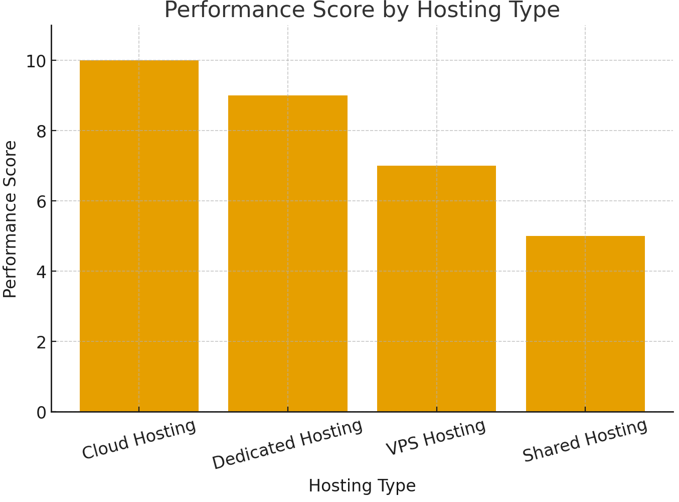
- Cloud Hosting is the best in terms of speed, reliability, and scalability, scoring the highest (10).
- Dedicated Hosting (9) allows for strong performance as servers and storage are dedicated resources.
- VPS Hosting offers a good combination of reasonable pricing and dedicated resources, with a score of 7.
- Shared Hosting scores the lowest (5), as it has limited resources and less consistent performance.
- Performance generally appears to be better with isolated and resource-rich hosting environments.
- For businesses that require higher uptime and speed, Cloud or Dedicated hosting is recommended according to budget and growth potential.
Example Case Study
After launching more products, and increased traffic during sales, customers complained about the site’s page loading time. A store that switched to reliable hosting reported faster website loading, lower bounce rates and higher sales and customer retention. This shows how reliable hosting can positively affect business.Practical Tips for Choosing the Best Hosting Provider
Careful thought and consideration of features, price and future requirements is a requirement for reliable web hosting. Businesses should choose web hosts based on performance ratings, security features and support instead of only price.Check Uptime Guarantees and Server Locations
Providers should offer a minimum of 99.9% service availability. Server locations can also determine loading speed, so servers must be situated in locations close to users.Evaluate Security Features and Update Policies
Automated backups, support for SSL, firewalls and malware detection are other misconfigurations that leave sites and users vulnerable.Review Scalability and Resource Flexibility
Business websites expecting to scale should select a scalable hosting option. Cloud and VPS hosting are both flexible and scalable options.Small Bullet List: Key Factors to Consider
- On-demand scalability options
- Strong security protocols
- Reliable customer support
- Consistent speed and uptime records
Recap
Solid web hosting cymru establishes an effective online presence for a website. By hosting with reputable providers, businesses benefit from faster page loads, improved security for all, and visitors experience an overall better time. This article covered the architecture of hosting systems, performance comparison, distinctions in hosting, and tips for selecting hosting. In this way, businesses can determine the kind of hosting that best suits their needs, thereby ensuring their web host will provide a consistent online experience for both the business and its customers.Check out our Socials:


Leave a comment